ASX Rare Earth Stocks 2025: China–US Tensions Move the Market
Geopolitical jockeying puts the spotlight on ASX rare earths companies
China’s tightening grip on rare earths exports is sending shockwaves through global markets — and the ASX is feeling it. As Beijing adds new restrictions, the United States is responding with unprecedented funding, stockpiling, and collaborative projects to secure supply. The result? A dramatic rally in some rare earth elements and ASX-listed producers.
In just a month, Arafura (ASX: ARU) has doubled, while Lynas (ASX: LYC) is up another 30%.
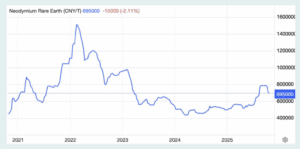
Where will Rare Earths Prices go Next?
5-year Neodymium Rare Earths price in Chinese Yuan per tonne.
Investment Summary: Time to Take Profits
At Under the Radar Report, we see this as a time for smart investors to take some profits.
The market’s recent rally has been driven more by geopolitics than fundamentals — and those winds can change quickly.
China could just as easily turn the taps back on, flooding the market and putting new projects under pressure. Or it could tighten restrictions even further. Either scenario creates volatility that few miners can withstand.
Even a shovel-ready project like Arafura’s Nolans Project in the Northern Territory isn’t expected to start producing until the late 2020s. Rare earth mines take years — sometimes decades — to come online.
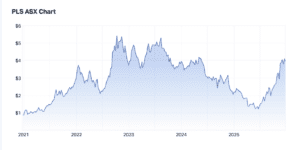
Lynas (ASX: LYC) 5-year Share Price Chart
LYC is rallying on U.S. funding support and China’s export curbs. That’s why Lynas remains our preferred core holding. It’s the largest non-China rare earths producer, and while we’re taking profits, we’re also maintaining a position.
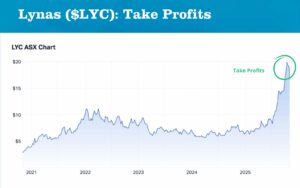
Lynas (ASX: LYC) 12-Month Share Price — rallying on U.S. funding support and China’s export curbs.
Arafura (ASX: ARU) 5-year Share Price Chart
By contrast, Arafura remains a sell in our view.
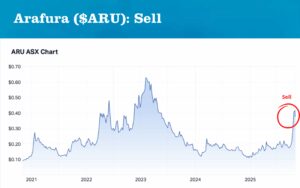
Arafura (ASX: ARU) Share Price — despite heavy government backing, project delays weigh on sustainability.
Despite a raft of government support — including another US$100 million from Australia’s NRF and potential US$300 million from the U.S. Export-Import Bank — the company’s economics remain heavily dependent on government intervention.
Abundant vs Scarce: The Price Gap Widens
The rare earths market is far from uniform.
-
Light rare earths like lanthanum and cerium, used in catalysts and glass polishing, remain oversupplied and cheap — often trading between US$1–3/kg.
-
Heavy rare earths, such as dysprosium and terbium, tell a different story. These elements are crucial for high-temperature magnets used in EV motors and defence systems.
This year, Dysprosium Oxide has more than doubled from US$350/kg to nearly US$800/kg, while Terbium Oxide has surged to US$870/kg, after briefly touching US$1,000/kg in mid-2025.
The table below summarises the prices for some key rare earth oxides:
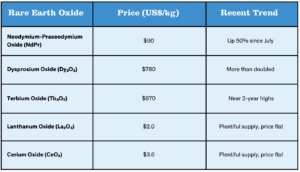
China’s Grip Tightens
China controls roughly 70% of rare earth ore production and over 90% of global processing capacity — giving it enormous leverage.
Earlier this month, Beijing announced an expansion of export restrictions ahead of high-level talks with the U.S. President.
Five new elements — holmium, erbium, thulium, europium, and ytterbium — were added to China’s controlled list, bringing the total to 12 of 17 rare earths now under license.
Crucially, China also extended restrictions to cover technologies and equipment used in processing. This means even foreign firms using Chinese feedstock or technology now need an export license, tightening China’s grip over the supply chain.
The Western Response: Stockpiling and Investment
The United States and Europe are not standing still.
-
The U.S. Department of Defence has fast-tracked a US$1 billion critical minerals stockpile,
-
MP Materials, America’s only rare earth miner, received Pentagon support and halted all exports to China,
-
Lynas secured funding for its Texas separation plant, and
-
Energy Fuels gained backing for a new rare earth initiative in Utah.
Australia has joined the movement, too — the National Reconstruction Fund Corporation made its first-ever investment: $200 million into Arafura’s Nolans Project.
Long-Term Demand: EVs, Defence, and Energy Transition
The long-term demand outlook for rare earths remains strong.
Electric vehicle sales continue to break records, driving demand for NdFeB permanent magnets used in EV motors.
In defence, rare earths remain irreplaceable in advanced systems — from precision-guided munitions and fighter jets to lasers and radar systems.
This growing demand supports higher prices and makes new projects more viable. However, refining capabilities outside China are still years away from maturity. Even with government support, China is expected to control 75% of global refining capacity by 2030, according to the International Energy Agency.
Under the Radar Report View: Balance Opportunity and Risk
The rare earths market is defined by booms and busts — and right now, we’re near a peak in sentiment.
For investors, this is the time to trim positions, protect profits, and maintain exposure only to high-quality operators.
-
Lynas (LYC): Take partial profits but maintain a core holding.
-
Arafura (ARU): Sell — overdependent on subsidies and project delays.
The long-term outlook for rare earths remains bullish, but in the short term, geopolitics trumps geology.
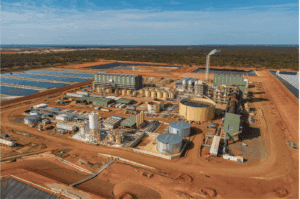
Photo: Lynas
Key Takeaway
“Governments are pouring billions into critical minerals, but China still calls the shots. Investors need to stay nimble.” — Under the Radar Report, October 2025
You don’t need to guess where the next boom will hit. Stay ahead with research from Under the Radar Report. Australia’s experts in small cap mining and ASX stock analysis.
Related Articles


Start Investing
Flexible access to expert ASX research, without the long-term commitment.

Small Caps Research
Uncover high-growth opportunities
$69.70/mo

Blue Chip Research
Build a strong, reliable core
$22.70/mo



Richard Hemming
Founder, BA (Econ, maths statistics), FSIA
Richard is an experienced equities analyst, stockbroker, and financial editor, having worked for over 30 years in finance.