The term ‘small cap’ refers to a company’s market capitalisation, the total market value of all its shares on issue. There is no single universal definition, but in the Australian context the following ranges are broadly accepted:
ASX Small Caps List
A Sector-by-Sector Guide for Australian Investors
If you’ve been searching for an ASX small caps list, you’re not alone. The Australian Securities Exchange is home to more than 2,000 listed companies, and the vast majority of them, well over 1,400, qualify as small caps. That’s a lot of ground to cover. This page gives you a practical starting point: what actually qualifies as a small cap on the ASX, how the official small cap index works, and a curated ASX small cap stocks list, sector-by-sector breakdown of small cap companies worth knowing about. It’s designed to help you understand the landscape, not overwhelm you with an unfiltered list of tickers.
What Qualifies as a Small Cap on the ASX?
Large cap
$10
billion+
e.g., BHP, CBA, CSL
Mid cap
$1 billion
to $10 billion
e.g., NST, RHC, DNL
Small cap
Under $300m
to $2 billion
Stocks covered in this guide
Micro cap
Under $50 million
Penny Stock Explorers and early stage companies
* The definition varies depending on which index or fund manager you speak to. S&P Dow Jones (who manage the official ASX indices) use a different threshold to many fund managers. For practical investing purposes, most Australian investors consider a small cap to be any company outside the ASX 100 with a market cap under $2 billion.
What matters more than the exact number is understanding what this segment of the market represents: companies that are past the start-up phase (they’re listed and typically trading), but still small enough that they haven’t yet been discovered by the major institutional funds. That’s where the opportunity, and the risk, comes from.
The ASX Small Ordinaries Index: The Official Benchmark
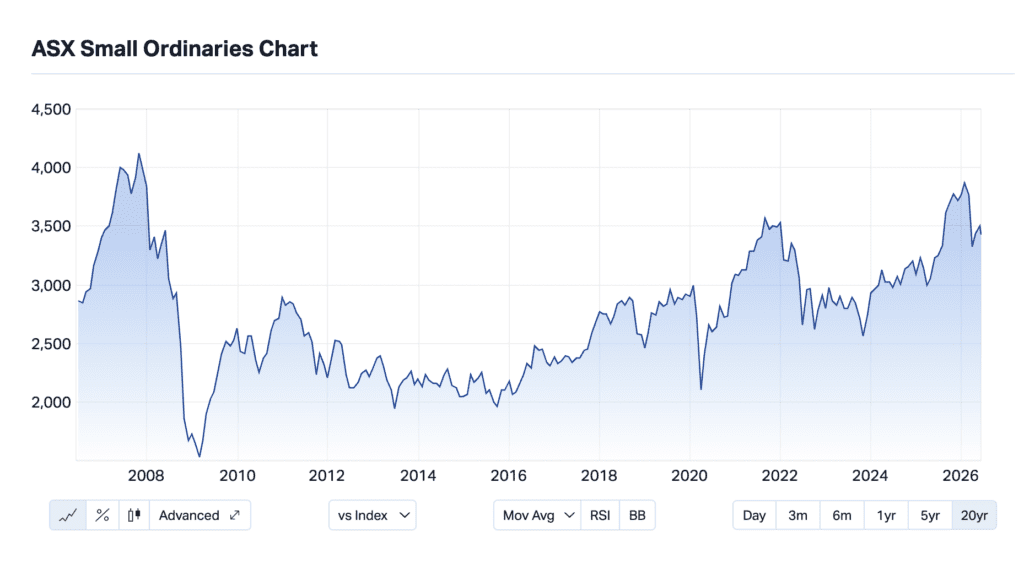
The S&P/ASX Small Ordinaries Index (ticker: XSO) is the official benchmark for ASX small cap performance. It is managed by S&P Dow Jones Indices and tracks the performance of companies in the S&P/ASX 300 that are not included in the S&P/ASX 100.
S&P/ASX Small Ordinaries (XSO): it covers the smaller 200 companies in the ASX 300. These are legitimate, established businesses, they’re in the top 300 on the ASX by size, but they’re not yet large enough to be in the ASX 100.
Key Facts about the XSO:
- Rebalanced quarterly, so its composition changes as companies grow or shrink
- Covers roughly 200 stocks at any given time
- Includes companies across all sectors: mining, energy, technology, healthcare, financials and more
- Excludes the 100 largest ASX companies (which are in the ASX 100)
- Often used by fund managers as the performance benchmark for small cap fund
Where to track it: You can track the XSO on the ASX website, through your broker’s platform. It gives you a quick read on how the small cap segment as a whole is performing relative to the broader market.
One important distinction: the XSO only covers companies inside the ASX 300. Many smaller companies – those ranked 301 and beyond by market cap fall entirely outside the index. These ‘ex-300’ small caps are often where Under the Radar Report finds its most compelling opportunities, precisely because they receive so little coverage.
ASX Small Cap Stocks List: A Sector-by-Sector Breakdown
Rather than dumping 1,400+ tickers on a page (which would help no one), the following is a curated sector-by-sector overview of notable small cap companies on the ASX. These are companies with genuine business models, real revenues or resource assets, and meaningful activity in their sector.
This list of small cap stocks ASX is intended as a starting point for your own research, not a recommendation to buy any of these stocks.
How to Use a Small Caps List as an Investor
“A list of ASX small cap stocks is a starting point, not a strategy.
Here’s what experienced small cap investors know that beginners often don’t:
A ticker is not a thesis.
Knowing that DYL is a uranium explorer doesn’t tell you whether it’s worth buying. You need to understand the asset quality, the management team, the balance sheet, and where uranium is in its price cycle. A list gets you to the right door, it doesn’t open it for you.
Small cap research is scarce by design.
The major broking houses don’t cover most small caps because there’s not enough brokerage revenue in it for them. That information vacuum is exactly why independent research services exist, and why well-researched small cap picks can generate outsized returns when the broader market eventually catches up.

The index is not the opportunity.
The XSO only covers companies in the ASX 300. The most compelling small cap opportunities are often outside the index entirely, companies with $50m to $300m market caps that are growing rapidly but haven’t yet attracted institutional attention.
Diversification matters more in small caps.
Individual small cap stocks carry higher binary risk than blue chips. A portfolio of 15–20 well-researched small caps is very different from owning two. Position sizing and diversification across sectors is a fundamental discipline in this part of the market.
Under the Radar Report has been covering ASX small caps since 2011. Richard Hemming and the UTRR team focus specifically on the companies that major broking houses don’t cover, which is where the real small cap edge comes from.
Want to know which of these are actually worth buying?
Under the Radar Report’s small cap research subscribers get access to our current top picks, sector reports, and stock updates, curated by a team that has been covering ASX small caps for over 15 years.
Smart Start Bundle
A taste of real UTRR research, real results. Get the latest Small Cap & Blue Chip Reports +plus special bonuses. $47 one-time only
Small Cap Member
Join as a full member and get ongoing access to everything UTRR covers.
Best Stocks List
Looking to see more of our best small cap stocks before you jump in?
Discover Tomorrow’s Market Leaders
Uncover emerging ASX opportunities with independent small cap research focused on growth potential.

Build Wealth with Confidence
Access independent blue chip research designed to help you identify quality ASX companies for long-term growth.