




Richard is an experienced equities analyst, stockbroker, and financial editor, having worked for over 30 years in finance.
Housing vs Shares: Where will the next big returns come from?
Australian housing has been an extraordinary wealth creator for more than 30 years. But what if the next five are much duller?
Since the early 1990s, Australian house prices have essentially gone in one direction: up. For millions of investors, property has done much of the heavy lifting when it comes to building household wealth.
But after more than 30 years of strong returns, investors need to ask an important question.
What if the next five or ten years look very different?
Put falling house prices in context
A softer housing market is not necessarily a disaster for the majority of homeowners.
For people who have owned their home for five, ten or fifteen years, a period of weaker prices needs to be put in the context of the extraordinary gains that have already occurred.
And there is another important principle homeowners sometimes forget.
Buy and sell in the same market.
If you are selling one house to buy another, a lower selling price can also mean a lower purchase price.
The people most vulnerable to a significant housing correction are those on the margin who have recently paid more than they can comfortably afford.
For longer term homeowners, the bigger issue might not be a dramatic collapse in wealth. It could simply be that housing delivers much duller returns for a period while wages and incomes catch up.
After 30 plus years of exceptional gains, five years of relatively flat returns would not be extraordinary.
It would, however, mean investors need to think about where else they can grow their wealth.

Shares have one huge advantage
One of the greatest advantages of investing in shares is liquidity.
You can access your capital relatively quickly. That matters.
The trade-off is volatility.
And investors are being reminded that volatility is not confined to speculative companies. Large companies can move sharply when earnings or expectations disappoint.
But volatility also creates opportunity.
This is particularly true at the smaller end of the market.
Why we keep coming back to small caps
The great attraction of small cap stocks on the asx is simple.
A small company can become a big company.
That gives investors something that is very difficult to replicate elsewhere: the opportunity to find a multi-year multi-bagger, a stock that increases many times over from your original purchase price.
These opportunities occur more regularly than many investors realise.
At Under the Radar Report, finding these companies is what we specialise in.
Three stocks illustrate what we are talking about.
Austal $ASB: From around $1 to above $8
Shipbuilder Austal $ASB has been a great example.
We recommended Austal at prices as low as around $1. The shares eventually traded above $8 before falling back significantly from those highs.
It has been quite a ride.
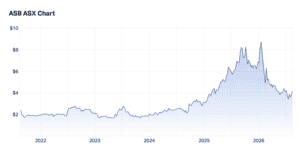
But behind the volatility is a structural growth story that we have followed closely for subscribers.
This week the stock spiked following renewed takeover interest from a Korean group. The same group made an approach a couple of years ago at lower levels, which we advised subscribers to ignore.
We continue to see value in Austal.
Read our Austal research to understand why.
Paladin Energy $PDN: Positioned for the nuclear boom
We also remain extremely positive about the long-term fundamentals supporting uranium and nuclear energy.
Demand is rising while the supply response remains constrained.
That is exactly the type of structural imbalance we like looking for.
Our latest Uranium Special Report explains the supply and demand fundamentals, why new uranium supply is difficult to bring to market and why nuclear power is increasingly important globally.
And, of course, we talk about the stocks.
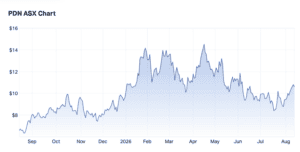
One of the companies that stands out is Paladin Energy $PDN, which we believe is positioned as one of the most important uranium producers for investors to watch.
If you want exposure to the nuclear theme, this is a report you should read.
Nick Scali $NCK: Growth plus dividends
Then there is Nick Scali $NCK.

Nick Scali is a company most Australian investors will recognise, but it has also been one of Under the Radar Report’s biggest winners.
We first recommended the stock at just over $1. It is now trading above $16.
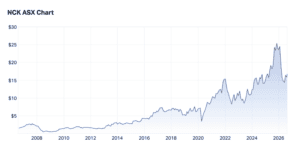
Importantly, investors have received dividends along the way. The dividend yield is close to 5 per cent and fully franked, supported by the profitability of its Australian business.
Its UK operation is currently a longer term project and has been losing money, but we believe there is substantial potential if management can successfully build that business.
There is also an obvious link back to housing.
If weaker house prices create a negative wealth effect, retailers such as Nick Scali can find themselves in the cross hairs.
But that does not mean avoiding the stock.
It means understanding the risks, buying at the right price and building a position accordingly.
The solution to dull house prices
Nobody knows exactly what Australian house prices will do over the next five or ten years.
But investors should not assume that the exceptional returns produced by residential property over the past 30 years will automatically continue.
That is where shares become increasingly important.
They provide liquidity, income and, most importantly, access to businesses capable of producing substantial long-term growth.
And at the smaller end of the market, the opportunities can be particularly powerful.
A shipbuilder: Austal $ASB
A uranium producer: Paladin Energy $PDN
A retailer: Nick Scali $NCK
Three very different businesses.
But each demonstrates why the sharemarket, and small caps in particular, can provide opportunities that property simply cannot.
Read our latest research and find out where we believe the next big returns could come from.