



Richard is an experienced equities analyst, stockbroker, and financial editor, having worked for over 30 years in finance.
The AI Reality Check Is Creating Big Opportunities
The AI Reality Check Is Creating Big Opportunities
Get Ahead with Small Caps and a Little Help from AI
What we are seeing in global markets represents a major opportunity for investors.
The key, as you may have guessed, is stock picking.
Artificial intelligence is at the centre of the latest market volatility. The enthusiasm surrounding AI has driven enormous gains in companies associated with data centres, semiconductors, optical fibre and computing infrastructure.
But markets are now beginning to ask a harder question:
Will the profits generated by AI justify the extraordinary amount of money being spent?
For some of the market’s former favourites, that reality check has come at a significant price.
Corning becomes an AI fallen angel
Corning is one of America’s bedrock technology and manufacturing companies.
It produces optical fibre used in communications networks and data centres, as well as specialist glass used in smartphones and other electronic devices. It is a genuine beneficiary of the enormous investment taking place in AI infrastructure.
That did not stop its shares from falling more than 20% after the company issued a weaker-than-expected sales outlook.
Since 30 June, Corning’s share price has more than halved.
The company has not suddenly become irrelevant. Optical fibre remains essential to the expansion of data centres and high-speed networks.
The problem was its valuation.
Investors had priced an enormous amount of future AI growth into Corning’s shares. When its outlook failed to meet those elevated expectations, the market reacted brutally.
It is an important reminder that even a high-quality company can be a poor investment when too much optimism is already reflected in its share price.
The AI reality check spreads
Corning is not alone. Tesla (see the share price chart below) has also been heavily sold as investors question whether future returns from robotaxis, artificial intelligence and humanoid robots will justify the company’s enormous investment expenditure.
The Nasdaq-100 has entered correction territory, falling more than 10% from its record high in early June.
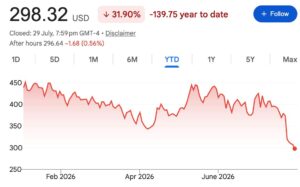
Large growth companies outside the immediate AI sector have also been hit. Australian healthcare giant CSL is one example of a high-quality growth stock that has suffered as investors become less willing to pay elevated valuations.
The lesson is straightforward:
Valuation matters
It matters even more when inflation remains persistent and investors are facing a higher-interest-rate environment.
Higher rates reduce the present value of profits expected many years into the future. That makes highly valued growth stocks particularly vulnerable when earnings expectations disappoint.
Investors can become so focused on the quality of a business or the size of an emerging theme that they overlook the price they are paying.
But the biggest factor in your eventual investment return is often the price you pay at the beginning.
That is why our central investment philosophy at Under the Radar Report remains:
Buy Cheap and Be Patient.
ETFs will not do all the work
ETFs have an important place in many portfolios. They provide diversification and allow investors to participate in the returns delivered by the broader market.
But an ETF is designed to track a market or index. At best, it helps you keep up with that market before fees.
It does not necessarily give you the growth required to get ahead.
Blue-chip companies can also be excellent sources of dividends and stability. However, investors relying solely on blue chips and index funds may miss many of the opportunities created by smaller, under-researched companies.
This is where stock picking becomes important.
We aim to identify quality assets when they are inexpensive and then give those businesses time to deliver.
Look for companies that are not dependent on AI hype
The strongest investment opportunities are not necessarily the companies making the biggest AI promises.
We want companies with sound balance sheets, strong competitive positions and growing earnings—with or without an AI boom.
This was the case with electrical and communications infrastructure contractor Southern Cross Electrical Engineering Group (SXE).
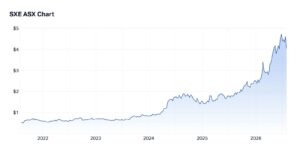
It was also the case with telecommunications network operator Superloop (SLC).
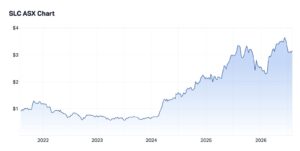
Both companies could benefit from increasing demand for digital infrastructure. But their investment cases were not based solely on speculative forecasts about artificial intelligence.
The underlying businesses already had strategic value.
That distinction matters.
Two words: mission critical
We recently examined the opportunities created by artificial intelligence in detail for Under the Radar Report members.
When assessing software companies, two words are particularly important:
Mission critical.
A mission-critical software product is one that a customer cannot easily remove without disrupting its business.
These systems may manage essential billing, customer information, transport networks, regulatory obligations or operational data. Once embedded, they can be difficult and expensive to replace.
This provides recurring revenue, customer retention and some protection against technological disruption.
Three ASX-listed companies we are watching closely are:
Gentrack Group ASX: GTK
Gentrack provides specialist software to utilities and airports.
Its systems help essential service providers manage complex billing, customer and operational requirements. These are not discretionary applications that customers can casually abandon.
Hansen Technologies ASX: HSN
Hansen supplies billing and customer-management software to telecommunications and utility companies.
Its products are deeply embedded within customers’ operations, giving the company a base of recurring revenue and long-term customer relationships.
Catapult Group International ASX: CAT
Catapult supplies performance technology, analytics and video systems to professional sporting organisations.
Its technology has become increasingly integrated into the way elite teams monitor athletes, analyse performance and make coaching decisions.
These companies offer potential value, but they are not without risk.
Software valuations can move rapidly, and investors are increasingly concerned about which businesses will benefit from AI and which may be disrupted by it.
That is why price and portfolio construction remain critical.
Balance growth with dividends
Owning several higher-growth technology stocks without balancing the risks can produce an uncomfortable portfolio.
Alongside selected software opportunities, we are also buying profitable small-cap companies that pay dividends.
Dividends provide investors with a tangible return while they wait for a company’s underlying value to be recognised. They can also be evidence that a business is generating real cash rather than relying entirely on promises of future growth.
The objective is not to avoid risk altogether. That is impossible when investing.
The objective is to ensure that the risks within a portfolio are balanced.
A diversified portfolio might include:
- Mission-critical software businesses with structural growth potential
- Infrastructure companies benefiting from digital investment
- Profitable small caps trading at attractive valuations
- Dividend-paying companies providing income and stability
Big market moves create opportunities
Large falls in well-known companies can be unsettling, but they also create opportunities.
The current volatility is forcing investors to reconsider the price they are willing to pay for AI-related growth. Some companies will prove that the market has underestimated their long-term potential. Others may show that their earlier valuations were built on unrealistic expectations.
Stock pickers do not need to predict the future of artificial intelligence perfectly.
We need to identify businesses with strong fundamentals, understand the risks and refuse to overpay.
That means looking beyond the biggest companies in the biggest indices.
It means finding quality small caps before the broader market fully recognises their value.
And it means balancing higher-risk growth opportunities with profitable dividend producers.
Buy Cheap. Be Patient. And use small caps to help your portfolio get ahead.
Discover our latest small-cap opportunities
Under the Radar Report provides independent research on undervalued ASX small caps, including growth companies, dividend producers and businesses positioned to benefit from long-term investment themes.
Members can read our latest research on the small-cap opportunities emerging from the AI revolution, including the companies providing mission-critical infrastructure and software.
Related Articles
Independent ASX Insights
Looking for the next big stock?
Small Companies.
Big Growth Potential.